
My Top Tip for Baking Fresh Milled Flour Breads
Baking with whole grain flour can be tricky. Let me share with you my top tip for baking fresh milled flour bread!
This post contains affiliate links. I may make a small commission on sales at no extra cost to you. As an Amazon Associate, I make commissions on qualifying purchases
If you are fairly new to baking with fresh milled flour, you may be wondering how you can get soft, lofty loaves.

Through the years, I have learned a tip that will make all of the difference in your loaves! I’m so excited to share this with you.
Kneading time matters (My Top Tip)
A couple of weeks ago, I decided to make my overnight, no knead sourdough sandwich bread (No knead sourdough sandwich bread) and used all freshly milled whole wheat.
The next morning, I was disappointed to see that the dough didn’t look quite right. Even though I did everything the same, the results were not as great as I wanted.
Of course the bread was delicious, but, I was hoping for a better rise and fluffier crumb.
If you are brand new to milling your own flour, START HERE!
I was kind of taken aback by the results and decided to back track and see if I could rectify this problem.
After some trial and error, I was able to pinpoint the issue. I wasn’t kneading the dough long enough!
I was kneading the dough per the recommendations for my mixer. However, what I have learned is, that though this time is appropriate for and all-purpose dough, it just wasn’t quite long enough for the whole grain dough.
I use the BOSCH MIXER for kneading my dough.
I was kneading the whole grain dough for 6-8 minutes. But, what I have found is that if I knead until it passes the window pane test, it was more like 15 minutes or so.
The window pane test is performed by pinching off a piece of dough and attempting to stretch it until you can see through it without it breaking.
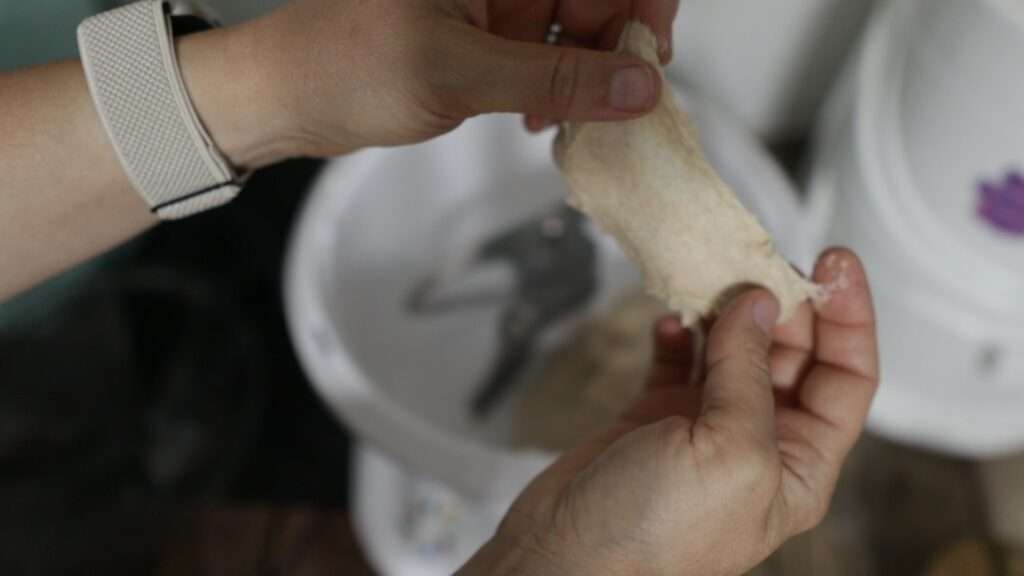
Instead of timing the kneading, I just knead until it passes the test. I know if I get to that point, the gluten is developed enough to have a good rise and fluffy crumb.
I mill all of my flour now and making all whole grain bread products.
I’m actually excited to bake with my freshly milled flour because I know the results are consistent and turning out the way I expect them to!
The grain mill I use: Nutrimill Grain Mill

Why Whole Grains?
I have went into this subject in another blog post: LINKED HERE!
The short story is that store bought whole wheat flour can be rancid because when you mill wheat berries all of the oils and all parts of the grain are in the flour which are components that will go bad rather quickly.
Store-bought flour is “dead”. All of the good components have been removed. Therefore, there aren’t any great health benefits from using it. This includes white flour or all purpose flour.
In my kitchen, my goal is to prepare the healthiest food with the healthiest ingredients. Milling my flour fresh before baking ensures that the bread I prepare is the most nutritious bread we can have.

The good news is, whole grain sourdough bread is not only nutritious, but, much more delicious! When you use all-purpose flour, you miss out on the nutty flavor of the whole grains as well as the health benefits of the whole grain.
Are you new to sourdough and want to make your own sourdough starter? CLICK HERE!
Grain Mills
There are several options of grain mills available from electric mills to manual mills.
Buying a flour mill is an investment and needs a good deal of consideration for your particular needs.
Basically, there are 2 main types of electric mills: Impact and Stone.
The milling process is similar but a stone mill may require a bit more of a learning curve. However, you have much more control over the coarseness and fineness of the flour.
If you are struggling with making a decision, I highly suggest you START HERE!
Considerations when converting your bread recipes to 100% fresh milled flour
In most cases, you can substitute fresh-milled flour for all-purpose flour 1:1 in your bread recipes. However, how much flour you need greatly depends on the environment of your kitchen (humidity, temperature).
Whole grain flour benefits from a longer soaking time to soften the bran and germ and ready the dough for proper kneading.
Although I don’t use it, some bakers really rely on vital wheat gluten added to their fresh milled doughs for building adequate gluten.
I find that the simple process of kneading longer makes all the difference.
A quick note on Ancient Grains
Keep in mind that this top tip will not necessarily work with ancient wheat like Einkorn, Kamut, or Spelt.
These ancient grains have a lower gluten content and actually get more sticky with longer kneading, especially with Einkorn.
With these grains, I prefer to do stretch and folds to slowly build gluten during the rising process.
Longer kneading techniques work best for hard wheat like hard white wheat and hard red wheat varieties.
Soft wheat, like ancient wheat has a very low gluten content and lower protein content and does not benefit from kneading.
Keep in mind, different grains will have different characteristics when baking with them. Familiarize yourself with all the varieties by slowing adding them to your recipes over time.
In conclusion
When baking with home-milled flour, it is very important to knead the dough long enough to develop the gluten and for the dough to pass the window pane test.
This can take anywhere from 10-20 minutes depending on the mixer you use or if you are kneading by hand.
You have the opportunity to convert your favorite recipes to fresh milled flour or you can use recipes that are made specifically for FRESH MILLED FLOUR.
Although it can be done, keep in mind that the flour will be quite hot and possibly lose a significant amount of the nutrients. Electric mills will create warm flour, however they are designed to keep the flour under the temperature that can damage these nutrients.
Yes, in most cases! You can proof your dough at room temperature of course, but keep in mind you will need to keep a watchful eye on it as it does tend to rise much faster in my experience. For best results, try doing the first rise on the counter and the second rise in the fridge.



Hi Mary! I’m new to watching your videos. I’ve been making your sourdough sandwich bread. What type of kneading machine do you recommend?
Hi Mary!
As someone who is relatively new to working with freshly milled flour, I SO appreciate this tip from you! It has really transformed our standard bread recipe. I use our Bosch mixer and will let it knead for even up to 30 minutes, waiting patiently for a successful windowpane test. My husband is delighted with the wonderful loaves of bread, pizza crust, and hamburger buns I have made following this simple rule. Thank you so much!