
Convert any Recipe to Fresh Milled Flour (Easy Tips)
If you are new to milling your own flour, you may be wondering if you can convert recipes to fresh milled flour that call for all-purpose flour.
Good news! With a few adjustments, it’s definitely doable! Using my tips, you can confidently convert any recipe to use fresh milled whole grain flour!
This post contains affiliate links. I may make a small commission on sales at no extra cost to you. As an Amazon Associate, I make commissions on qualifying purchases
How is Fresh Milled Flour different from All-Purpose Flour in recipes
Flavor – Store-bought flour from the store is void of any flavor. Fresh ground flour has a nutty, deep flavor that makes any recipe so much more delicious!
Bran and Germ – White flour has been sifted of the bran and germ. Unfortunately, this takes away all of the fiber, vitamin e, and nutrition. While this makes for a light, fluffy bread, it is devoid of any nutritional benefits.
How it behaves in baking – Fresh milled flour isn’t packed down into a bag like store bought flour therefore it measures a bit different than all purpose flour or bread flour. It also absorbs water at a different rate.
Fermentation time – Fresh milled flour tends to ferment more quickly than white flour.
Texture – Bread products made with fresh milled flour are typically a bit more dense because of the bran and germ. However, they are still soft and much more delicious.
Rise – When making bread recipes, you may notice that when substituting fresh milled flour the rise may not be quite as high and this is normal.
Brand new to home-milled flour? START HERE!
Want some help choosing the right grain mill? CLICK HERE!
Shop this post
There are a few different types of grain mills to choose from for milling your own wheat berries: (Note that these all fall within the “electric mill” category)
If you are looking for a stone mill, I use the NUTRIMILL HARVEST GRAIN MILL
On the other hand, you can also choose an impact style grain mill. I use the NUTRIMILL CLASSIC GRAIN MILL
Impact mills are less expensive than the wooden stone mills. If you are looking for the least expensive option, consider the NUTRIMILL IMPACT GRAIN MILL
A stand mixer makes the task of kneading your recipes made with whole grains so much easier. I have tried a few different ones.
My favorite by far is the BOSCH MIXER
Want to learn about using fresh milled flour in sourdough bread? CLICK HERE!
Print this CHART HERE!
Can you convert recipes to fresh-milled flour 1:1?
The answer is yes and no depending on the recipe and the wheat berry used. Know how much flour to use makes all the difference in the outcome of the recipe.
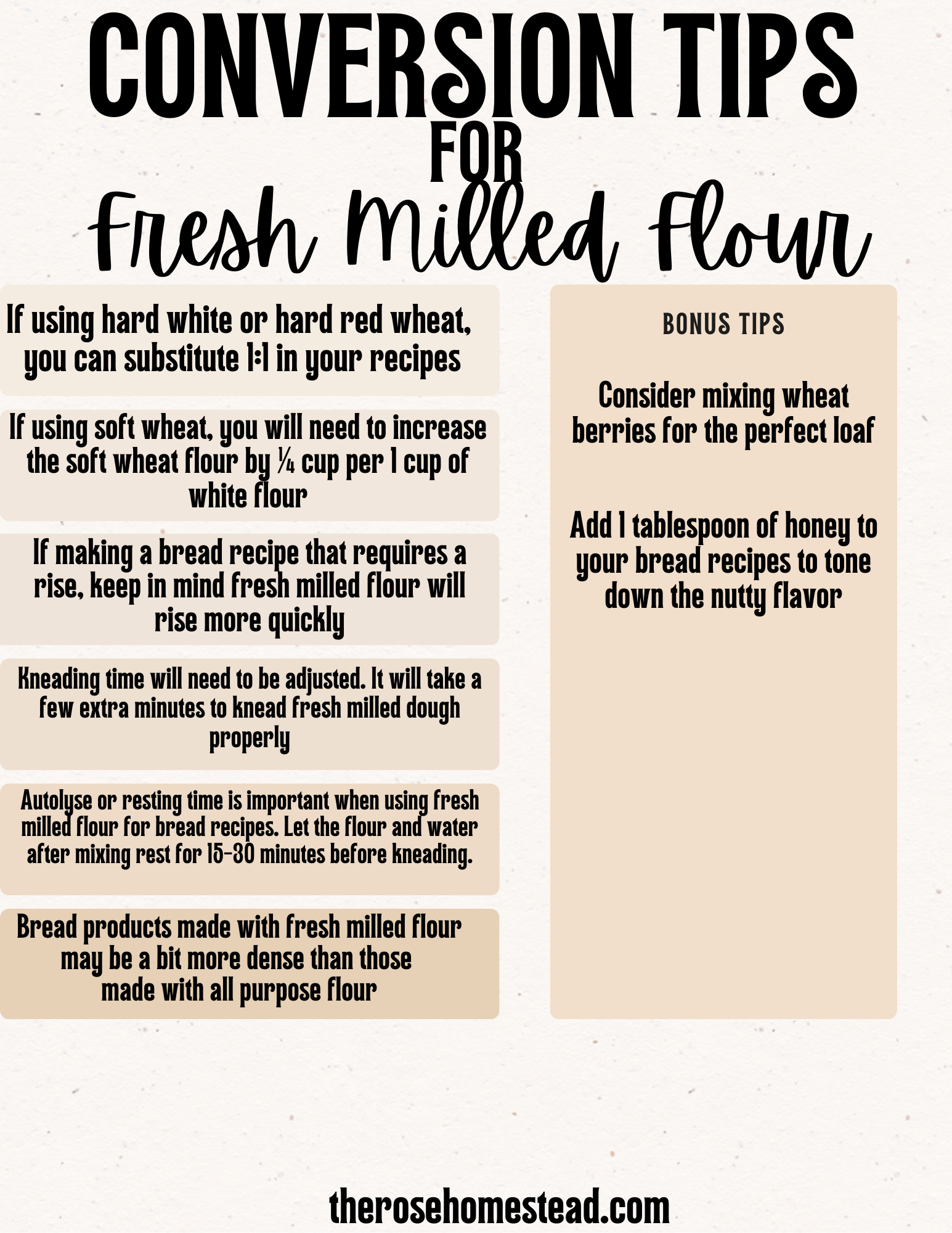
Soft Wheat Flour (pastry flour) – For best results, when using fresh milled soft wheat flour, you will need to adjust the amount of flour needed. The general rule is you need to add 1/4 cup more fresh flour per cup of regular flour. For instance, if the recipe calls for 1 cup of flour, use 1 1/4 cup of soft white wheat flour.
Hard White Wheat or Hard Red Wheat – The good news is because of the higher gluten and lower moisture of hard wheat flour, you can generally substitute 1:1 for recipes using all purpose flour.
Ancient Grains – Using ancient wheat is trickier, especially when using Einkorn flour. It’s a bit easier if using Kamut (Khorasan) or Spelt flour. Generally speaking, I suggest using recipes that are developed for ancient wheat to make it much easier.
The health advantages of ancient wheat are many, so in my opinion, it is worth the learning curve to use it in your baking.
Want to know where to get the highest quality, cleanest wheat berries? CLICK HERE!

Conversion Tips
Keep in mind, if you are making quick breads, biscuits, or pastries, autolyse, fermentation, and kneading DO NOT APPLY.
Resting/Autolyse – Bread made with fresh milled flour benefit greatly from a resting period. Generally, this will be the flour and water mixed together and allowing it to sit for 15-30 minutes to allow the bran and germ to soften.
NOTE: If making yeast breads, let soak for 15-30 minutes, if making sourdough bread, you can increase the resting time to an hour
You can add the oil and sweetener if they are called for in the recipe during this resting time.
Kneading – It may take a bit longer to knead fresh milled bread products properly although letting the flour and water autolyse first can help the kneading process.
Fermentation Time – Bread recipes made with fresh milled flour tend to rise more quickly than their white flour counterparts. To adjust for this, I recommend decreasing the rise time by 20-30 minutes.
Want my favorite sandwich bread recipe using fresh milled flour? TRY THIS ONE!

Common Problems when using Fresh Milled Flour
If you have fresh milled flour baking problems, consider these tips:
- Bread is too dense – Consider adding 2-3 tablespoons more of water to the recipe or adding an egg for a softer crumb.
- The bread turns out gummy – Try adjusting the baking time by adding 3-5 minutes. Checking the internal temperature with an instant read thermometer to make sure it is 205-210 degrees F will ensure it is done.
- You bread products are bitter – You may notice when you first start using fresh milled flour that the bread products have a lot more flavor that can be off putting at first. My advice is to add 1 tablespoon of honey to your recipes to offset this increase in flavor.
It is your prerogative; however I suggest not sifting your fresh milled flour. The full nutritional benefits will be less if you sift out some of the bran and germ. However, if you want a lighter fresh milled flour, sifting is a good option.
Absolutely! Fresh milled flour has 40/44 nutrients plus is high in fiber making fresh milled bread one of the healthiest foods you can make!
Yes! Read THIS ARTICLE for an in depth look at combining wheat berries for the best bread!
In Conclusion
It is entirely possible to convert your favorite recipes to fresh milled flour with just a few adjustments.
Leave me a comment if this was helpful and share with your fresh milled flour friends!





Thank-you! This was very helpful as I was just thinking about a recipe I would like to convert!
very Informative, thank you.
Hi Mary, thank you for this information, very helpful! I also live on a Homestead in northern Virginia and I am new to using fresh ground flour.
I’m experiencing my dough to be way too wet and sticky to even knead properly- I’m using the Bread Beckers yeast bread recipe- do you have suggestions? I’m also not getting a very good rise out of it and I’m wondering if I should be using quick rise yeast?
I would add 1 tablespoon of flour at a time until I get a dough that is workable. I prefer quick rise yeast myself and have great results. Let me know how that goes for you!
Thank you for all your helpful tips. I bake my bread by weight not by volume measurement. how would I substitute in that case?
Keep a cup of your flour out and then let what you mixed sit for 30 minutes. It gives it time to hydrate it, then add your last cup. I find if I keep adding flour my bread is crumbly. My mother in law has perfected her recipe. But the key is to allow some of the water to absorb into the flour. I hope that helps