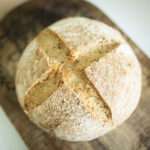
Multigrain Sourdough Bread
A hearty and flavorful loaf, this sourdough multigrain loaf if the perfect bread for sandwiches or toast.
Servings 12 slices
Calories 154.9kcal
Equipment
- 1 Dutch Oven
- 1 Banneton Basket
Ingredients
- 1 cup water (240 grams)
- 1/2 cup sourdough starter (120 grams)
- 1 1/2 tsp salt (11 grams)
- 3-3 1/2 cups flour (425 grams) I used freshly milled hard white wheat
- 2 tbsp sesame seeds
- 2 tbsp flax seeds
- 4 tbsp rolled oats
Instructions
- In a large bowl combine the water and starter. Mix well.
- Add 3 cups flour and the salt. Mix well.
- If dough is too sticky, add up to 1/2 cup more flour.
- Cover with plastic wrap and let dough rest for 30 minutes.
- After 30 minutes, start doing stretch and folds.
- To do a stretch and fold, pull up and over on a corner of the dough. Continue all the way around the bowl.
- Every 30 minutes do a set of stretch and folds covering the bowl in between. You want to do at least 3 or up to 6.
- In a small bowl, combine the grains.
- On the 3rd set of stretch and folds, add 1 tbsp of grains before folding the dough until all grains are used.
- Continue stretching and folding until the grains are evenly distributed throughout the dough.
- Cover and let rise for 4-6 hours.
- To shape the dough, turn it onto a work surface and much like stretching and folding, pull a corner up and over the dough all the way around.
- Turn the dough over and drag across the table to build surface tension.
- Place shaped dough seam side up in a banneton basket that is lined with a tea towel that is generously sprinkled with flour.
- Cover and place in the fridge until ready to bake. You can leave the dough in the fridge for several days. It will continue to ferment very slowly.
- Alternatively, you can finish the second rise on the counter, covered for 1-2 hours.
- Preheat a dutch oven in the oven to 450 degrees F.
- Turn the dough onto a piece of parchment paper.
- Score the top with a sharp knife or lame.
- Carefully take the dutch oven out of the oven and lower the loaf in.
- Cover and let bake for 20 minutes.
- Uncover and continue to bake for 15 minutes until deeply golden brown.
- Let cool on a cooling rack completely before slicing.
Notes
Storage Tips:
Store in a plastic bag on the counter for 3-4 days.
Store in the freezer in a freezer safe bag for up to 3 months.
You can use any grains you have on hand, such as pumpkin seeds, a cereal mix, poppy seeds, or sunflower seeds.
Nutrition
Serving: 1slice | Calories: 154.9kcal | Carbohydrates: 27.9g | Protein: 4.8g | Fat: 2g | Saturated Fat: 0.64g | Polyunsaturated Fat: 1.15g | Monounsaturated Fat: 0.77g | Sodium: 938mg | Potassium: 45.4mg | Fiber: 1.67g | Sugar: 0.08g | Calcium: 22.5mg | Iron: 0.83mg