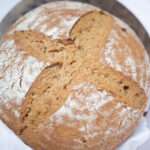
Einkorn Sourdough Artisan Bread
An incredibly flavorful loaf of sourdough bread made with Einkorn flour. This ancient wheat adds a nutty flavor that compliments the tang from the sourdough starter.
Servings 12 slices
Calories 137.5kcal
Equipment
- 1 Dutch Oven
- 1 Banneton Basket may use a medium bowl or colander
Ingredients
- 1 cup water (256 grams)
- 1/2 cup sourdough starter (130 grams)
- 1 1/2 tsp salt (9 grams)
- 4 1/2 cups Einkorn Flour (460 grams)
Instructions
- In a large mixing bowl, combine the water and starter.
- Add 2 cups of flour and the salt. Mix well.
- Add the remaining flour and mix until you have a shaggy dough. I use a danish dough whisk for the mixing.
- Cover with plastic wrap and let dough rest for 30 minutes.
- Turn the dough onto a floured surface and gently lift each corner and fold it onto itself in the center of the dough. Using a bench scraper makes this much easier.
- Return dough to the bowl, cover and let rest 30 minutes.
- Continue this process 4 times.
- After the last fold, cover and let ferment for an additional 3-5 hours.
- Prepare your banneton basket by generously flouring or add a linen cloth/tea towel and generously flour the cloth. See notes below.
- Turn the fermented dough onto a floured surface.
- Shape the dough much in the same way you folded it before. Gently pull each corner and fold it back into the center of the dough all the way around.
- Turn the dough over and drag against the counter to build surface tension.
- Place dough seam side up in the banneton basket.
- Cover and let rise an additional 1-2 hours.
- Alternatively, you can place basket in the fridge and bake when it is convenient for you. The dough will still ferment just more slowly.
- Preheat the oven with the dutch oven inside to 450 degrees F.
- Once preheated, turn the shaped dough onto a piece of parchment paper.
- Using a sharp knife or razor, slash the top of the dough about 1/4 inch deep.
- Carefully remove the dutch oven from the oven and remove the lid.
- Place the dough into the dutch oven using the corners of the parchment paper.
- Return lid and bake in preheated oven for 20 minutes.
- Remove lid and continue to bake for 15 minutes.
- Bread should reach an internal temperature of 195-205 degrees F.
- Allow the bread to cool completely before slicing. See storage tips below.
Notes
Rice flour works incredibly well for flouring the banneton basket. Keep in mind it's okay to over flour than under flour. You can always brush excess flour away, however if the dough gets stuck it is near impossible to remove.
Store cooled bread in a plastic bag for 3-5 days on the counter.
Freeze this bread in a freezer safe bag for up to 3 months.
Nutrition
Serving: 1slice | Calories: 137.5kcal | Carbohydrates: 29.33g | Protein: 4.33g | Fat: 0.33g | Saturated Fat: 0.04g | Polyunsaturated Fat: 0.13g | Monounsaturated Fat: 0.17g | Sodium: 341.67mg | Potassium: 45.83mg | Fiber: 0.92g | Sugar: 0.08g | Calcium: 2.5mg | Iron: 0.43mg